
A tense encounter can change quickly depending on what happens in the first few moments. A raised voice, frustrated customer, agitated visitor, or disagreement over access may not begin as a serious security threat, but the way a guard responds can influence what happens next.
Conflict de-escalation training for security guards focuses on recognizing warning signs, communicating clearly, maintaining appropriate boundaries, and reducing tension when circumstances allow.
It can also help guards assess when verbal strategies are appropriate and when a situation requires additional assistance or a different safety response. For security professionals who regularly interact with the public, technical procedures are only part of effective preparation.
Developing sound judgment and communication skills can help guards manage difficult encounters more professionally while supporting safer outcomes for themselves, clients, employees, and visitors.
Conflict De-escalation Training for Security Guards
How Can De-Escalation Training Reduce Liability Risk?
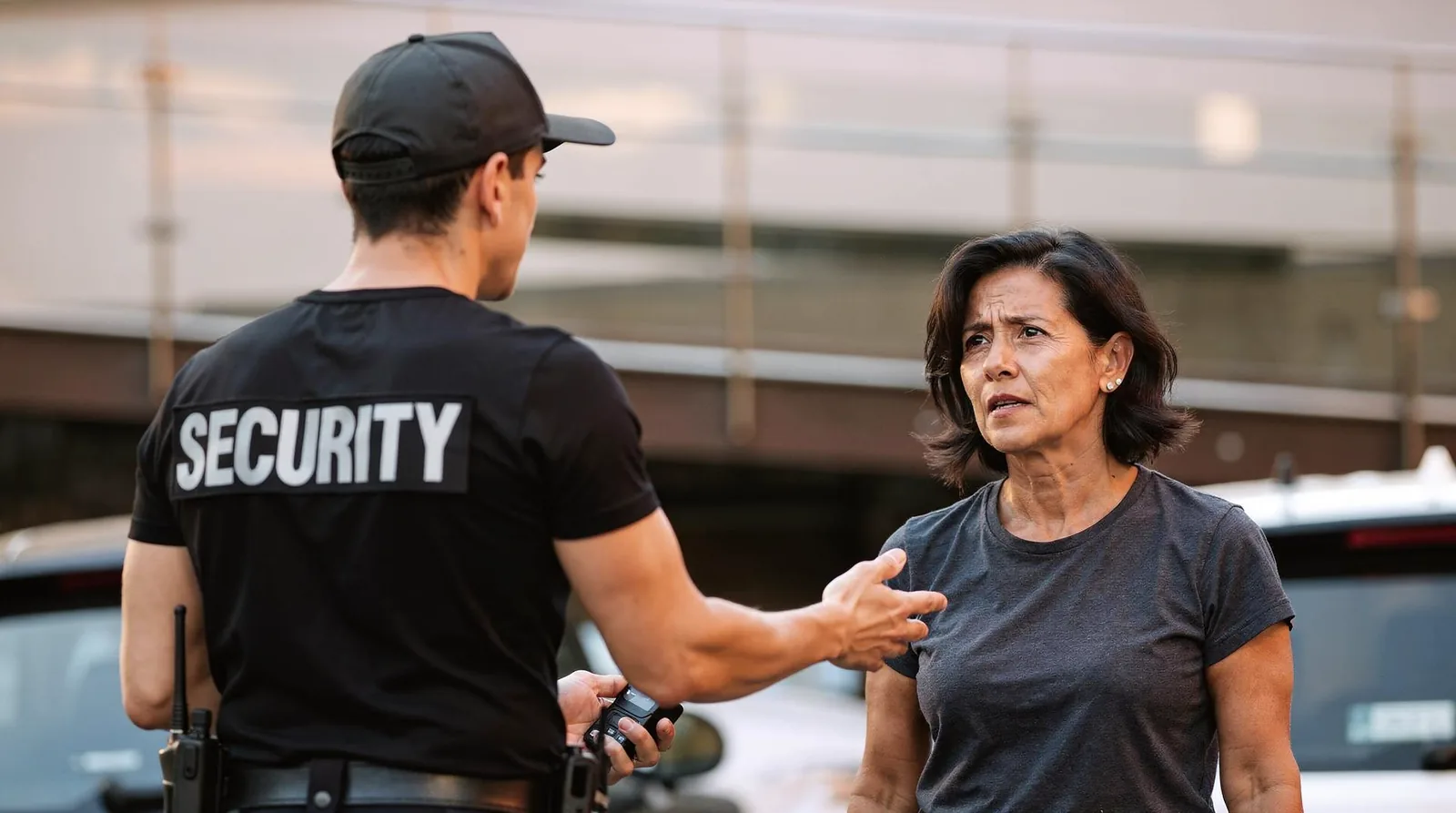
Security personnel often become involved when emotions are already high. A dispute at an apartment community, an angry customer in a retail setting, or a confrontation at an event can quickly become more serious if communication breaks down or the response is disproportionate to what is happening.
That is why conflict de-escalation should be treated as a risk-management skill rather than simply a customer-service technique.
Training cannot eliminate the possibility of injuries, complaints, claims, or litigation, but it can give officers a more structured way to assess tense situations, communicate clearly, and recognize when a different level of response is necessary.
De-Escalation Creates More Options Before Force Is Considered
A security officer who knows how to slow an interaction down has more choices than one who immediately moves toward confrontation.
Useful techniques can include maintaining a controlled tone, giving clear instructions, listening for the actual source of the dispute, avoiding unnecessarily provocative language, creating physical space when appropriate, and allowing a person time to comply.
These skills are especially valuable when someone is frustrated rather than immediately dangerous. Training in security customer service and conflict resolution can help officers distinguish between behavior that requires firm intervention and situations where calm communication may prevent the encounter from becoming physical.
Clear Procedures Reduce Improvised Decisions
Liability risk can increase when officers are forced to invent a response in the moment without clear expectations.
A well-designed security program should establish when an officer is expected to intervene, when management should be contacted, when law enforcement or emergency services should be called, and what actions fall outside the officer’s role.
Conflict de-escalation training supports those procedures by giving officers a repeatable framework for the period before a situation reaches that threshold.
Instead of relying only on instinct, the officer can assess behavior, communicate boundaries, monitor changes in risk, and escalate the response through established channels when necessary.
Documentation Matters After the Incident
How an incident is handled is only part of the risk picture. Accurate documentation can help property managers, employers, insurers, investigators, or legal counsel understand what happened afterward, particularly when different people provide conflicting accounts.
Incident reports should focus on observable facts rather than assumptions about motive. Useful documentation may include what the officer saw or heard, instructions that were given, actions taken by the individuals involved, when supervisors or law enforcement were contacted, and how the incident concluded.
Training Should Match the Environment
A guard working in a residential lobby faces different types of interactions from an officer assigned to a retail center, construction site, corporate property, or large event. Training is stronger when it reflects those differences instead of treating every conflict as the same type of security problem.
Professional security guard services should therefore be evaluated partly on how officers are prepared for the specific site and post.
Facility managers can ask how guards are trained in communication, conflict resolution, emergency escalation, documentation, and site-specific procedures before deployment.
De-Escalation Is Not the Same as Avoiding Intervention
Effective de-escalation does not mean an officer should continue talking indefinitely when someone presents an immediate threat.
Security personnel still need to recognize situations that require disengagement, additional support, emergency services, or another response permitted by their training and authority.
The purpose is to avoid unnecessary escalation while preserving the ability to act when circumstances genuinely require it. That distinction matters because a calm response should never depend on ignoring obvious danger.
For businesses and property managers, the broader value of conflict de-escalation is consistency.
Officers who understand how to communicate, assess risk, follow escalation procedures, and document what occurred are better positioned to handle difficult encounters professionally, while organizations gain a clearer and more defensible process for managing incidents when they do occur.
What Skills Make Verbal De-Escalation Actually Work?
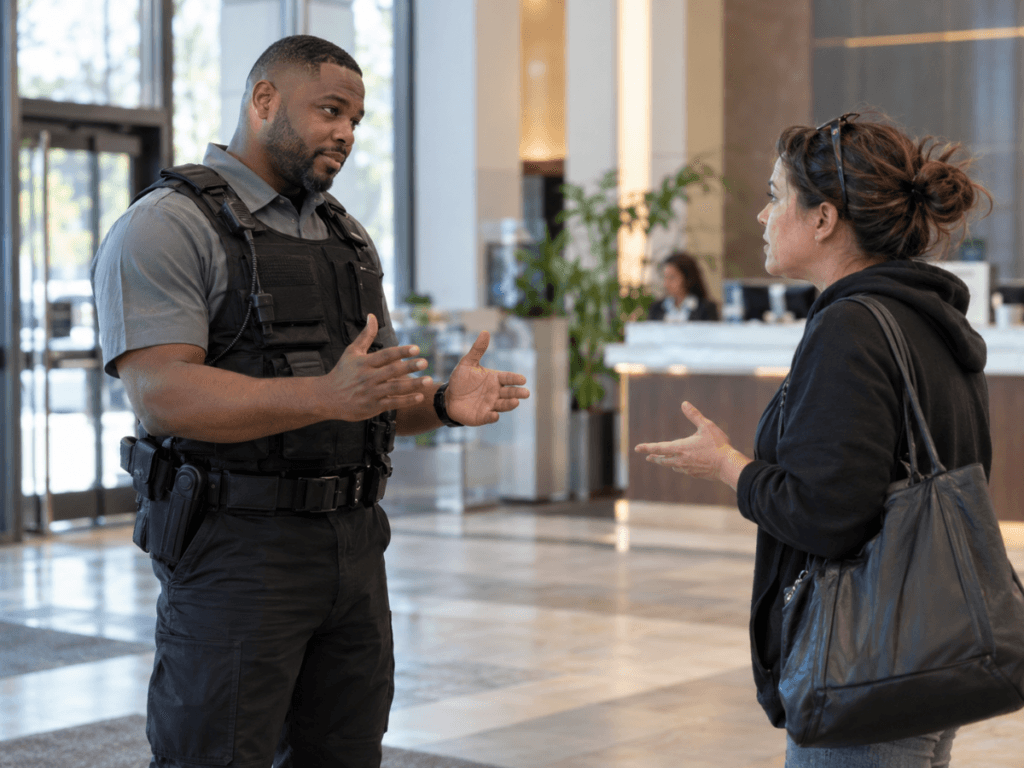
Effective conflict de-escalation is less about memorizing the perfect phrase and more about managing the interaction as it changes. Security officers need to listen, regulate their own responses, communicate expectations clearly, and recognize when a conversation is becoming more or less volatile.
Those skills work together. A calm tone loses much of its value if the officer interrupts constantly, gives confusing instructions, or crowds the other person, while respectful language alone will not resolve a situation if boundaries are vague.
Listen for the Problem Behind the Reaction
Active listening helps an officer understand what the person is actually disputing. Someone arguing at an entrance, for example, may be frustrated about a policy, confused about instructions, or angry because they believe they have been treated unfairly.
Recognizing the issue does not require agreeing with the person’s behavior or demands. It allows the officer to respond to the substance of the problem instead of reacting only to raised voices, insults, or frustration.
Use Clear Language and One Direction at a Time
Complicated explanations can make tense interactions harder to follow. Short, specific instructions such as where someone needs to stand, what action needs to stop, or what option is available next are easier to process than several commands delivered at once.
Word choice matters too. Neutral descriptions of behavior are generally more useful than labels or assumptions about intent, especially when an officer needs to establish a firm boundary without turning the exchange into a personal argument.
Control Pace Without Becoming Passive
Slowing an interaction does not mean surrendering control. Strategic pauses, an even speaking pace, and allowing time for a person to answer can reduce the pressure that comes from rapid back-and-forth exchanges.
At the same time, conflict de-escalation still requires clear limits. Officers should be able to state what behavior is unacceptable, what needs to happen next, and what response may follow if the situation crosses an established safety threshold.
Read Changes in Behavior, Not Just Words
An officer should continue assessing the interaction instead of assuming that an initially angry person is either calming down or becoming dangerous.
Changes in voice, movement, distance, attention, cooperation, and responsiveness can provide useful information about whether the current approach is working.
This makes verbal de-escalation an active process rather than a script. The officer communicates, observes the response, adjusts where appropriate, and recognizes when communication is no longer enough and established escalation procedures need to take over.
Strong conflict de-escalation therefore depends on judgment as much as vocabulary. Listening, concise communication, controlled pacing, behavioral observation, and firm but respectful boundaries give officers practical tools for handling difficult encounters without assuming every disagreement requires the same response.
How Does Southeast Security Train Guards to De-Escalate?
De-escalation training should prepare security officers to make sound decisions before, during, and after a tense encounter. That requires more than learning a few calming phrases.
Officers need practice recognizing developing problems, communicating under pressure, following site procedures, and knowing when verbal intervention is no longer appropriate.
Southeast Security Services describes conflict resolution, emergency response, situational awareness, and professional communication as parts of its broader employee training and development.
That combination matters because effective conflict de-escalation depends on judgment as much as verbal technique.
Training Starts With Situational Awareness
Officers first need to recognize that an interaction is changing. Raised voices may be obvious, but useful observation also includes changes in behavior, movement, personal space, cooperation, and attention that may indicate growing agitation or a developing safety concern.
Early recognition gives the officer more options. Instead of waiting until an argument becomes a physical confrontation, the officer may be able to adjust positioning, clarify a rule, involve a supervisor, separate people, or use calm communication while the situation is still manageable.
Officers Practice Communication, Not Just Commands
Security work often requires officers to enforce policies without unnecessarily turning disagreement into confrontation. Clear explanations, concise instructions, active listening, controlled tone, and respectful boundaries can help an officer communicate authority without making the interaction more adversarial.
This is particularly important in customer-facing settings. In its discussion of retail loss prevention, Southeast Security notes that guards may need to recognize suspicious behavior, approach people professionally, use de-escalation when emotions rise, and involve management or law enforcement when appropriate.
Scenario Context Changes the Response
Conflict de-escalation should not be treated as a universal script because different assignments create different types of encounters.
A retail officer may be dealing with suspected theft or an upset customer, while an officer at an apartment community may encounter resident disputes, access problems, noise complaints, or conflicts involving guests.
Training is more useful when officers understand both general de-escalation principles and the expectations of the site where they are working.
The appropriate response depends on the behavior involved, available backup, site policy, the officer’s authority, and whether anyone faces an immediate safety threat.
Officers Need Clear Escalation Thresholds
Successful de-escalation does not require an officer to keep talking when conditions become unsafe. Training should help personnel recognize when communication is working, when another approach is needed, and when the situation should be transferred to supervisors, emergency personnel, or law enforcement.
That distinction prevents de-escalation from becoming hesitation. An officer can attempt to lower tension while still maintaining boundaries, monitoring risk, protecting access points, and preparing to follow established response procedures if circumstances deteriorate.
Documentation Completes the Response
Training should also address what happens after the immediate conflict ends. An officer who handled the interaction appropriately but records only a vague description leaves managers with little information if the incident later produces a complaint, investigation, or internal review.
Strong reports focus on observable details. Officers should document what occurred, what they personally saw or heard, what instructions were given, how the people involved responded, what actions the officer took, and when another party such as management or law enforcement became involved.
Ongoing Training Matters More Than a One-Time Lesson
De-escalation skills involve communication and judgment under stress, which makes reinforcement important. Southeast Security states that its employee development includes regular training and that conflict resolution is among the areas covered in its training programs.
For facility managers evaluating a security provider, that makes the training process worth examining directly. Ask how officers practice conflict de-escalation, how site-specific procedures are communicated, how supervisors reinforce expectations, and how incidents are reviewed afterward.
The quality of a program is easier to judge from those concrete processes than from broad claims that guards are simply “trained” to handle conflict.
Conflict De-Escalation FAQs
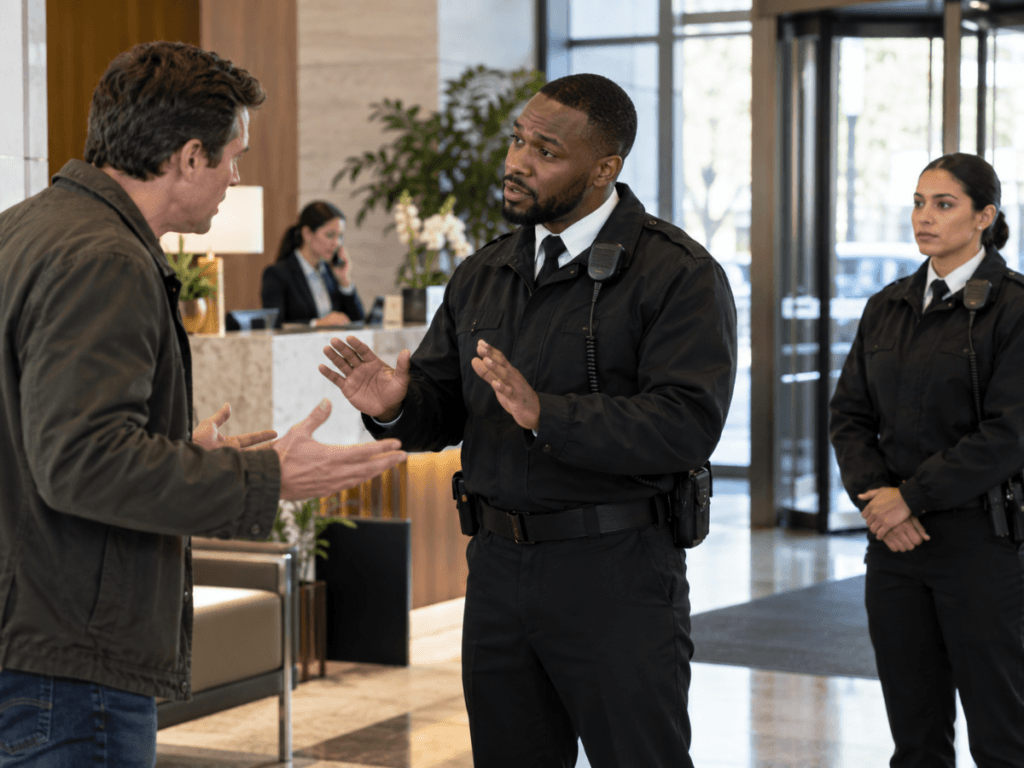
How Can De-Escalation Training Reduce Liability for Businesses?
Conflict de-escalation training can reduce risk by giving security officers a structured way to respond before an encounter becomes physical.
Officers who know how to assess behavior, communicate boundaries, call for assistance, and follow established procedures are less dependent on improvised decisions during stressful situations.
Training does not guarantee that a confrontation will end peacefully or prevent every complaint or claim. Its value is in creating a more consistent response process that can help avoid unnecessary escalation while giving businesses clearer expectations for how officers should handle difficult interactions.
What Should Facility Managers Look for in De-Escalation Training?
A useful program should go beyond generic instructions to “stay calm.” Facility managers should ask whether officers practice realistic scenarios, receive feedback on their communication, understand site-specific escalation procedures, and know when a supervisor, emergency service, or law enforcement agency should become involved.
Training should also address the types of encounters officers are likely to face at that particular property. Access disputes at an office building, resident conflicts at an apartment community, suspected theft in retail, and crowd problems at an event may require different communication and response strategies.
When Should an Officer Stop Trying to De-Escalate?
Conflict de-escalation is not appropriate as an indefinite response to every threatening situation. If behavior indicates an immediate safety risk, communication is no longer effective, or the circumstances exceed the officer’s authority or training, the next step may involve disengaging, requesting backup, contacting law enforcement, or following another established emergency procedure.
The important point is that officers should understand those thresholds before an incident occurs. De-escalation works best as one part of a larger response plan rather than as a substitute for action when conditions become dangerous.
Why Is Incident Documentation Important After a Conflict?
A clear report creates a record of what the officer observed, how the incident developed, what instructions were given, what actions were taken, and how the situation ended.
That information can help managers review the response, investigate complaints, identify recurring problems, and determine whether procedures or training need to change.
Good documentation should distinguish observable facts from assumptions. Consistent security incident report writing can also make later reviews easier by giving supervisors and other stakeholders a more complete account of the event.
How Can Businesses Tell Whether De-Escalation Training Is Working?
The strongest evaluation looks beyond whether an organization had few serious incidents.
Managers can review report quality, supervisor feedback, recurring complaint patterns, adherence to escalation procedures, and how officers perform during scenario-based refresher training. Individual incidents should also be reviewed for learning opportunities rather than judged only by the final outcome.
A difficult encounter may still reveal strong decision-making, while an incident that ended quietly may expose communication or procedural weaknesses worth correcting before a higher-risk situation occurs.
Conclusion
Conflict de-escalation training gives security guards practical skills for recognizing rising tension, communicating clearly, maintaining appropriate boundaries, and responding without unnecessarily escalating a difficult situation.
These skills can support safer interactions with employees, customers, residents, and visitors while helping guards make more measured decisions under pressure.
For organizations that need trained personnel as part of a broader security guard service, choose Southeast Security Services. Call (404) 504-7023 to discuss your property’s security needs, or fill out the website form to request your free estimate today.