
Large music festivals and live concerts bring together thousands of attendees, creating an exciting atmosphere that also demands careful planning and professional security.
Managing entry points, guiding crowd movement, responding to emergencies, and maintaining a safe environment all require experienced personnel who understand the unique challenges of high-attendance events.
Specialized crowd control services play a vital role in ensuring music festivals and concert security operations run smoothly from start to finish.
Through strategic planning, trained security teams, and effective communication, organizers can reduce risks, improve guest experiences, and respond quickly to unexpected situations without disrupting the event.
This guide explores the key elements of professional crowd management, the benefits of specialized event security, and how the right approach helps create safe, organized, and enjoyable live entertainment experiences.
Concert Security Strategies for Safe and Successful Events
Why Professional Crowd Control Matters at Concerts and Music Festivals
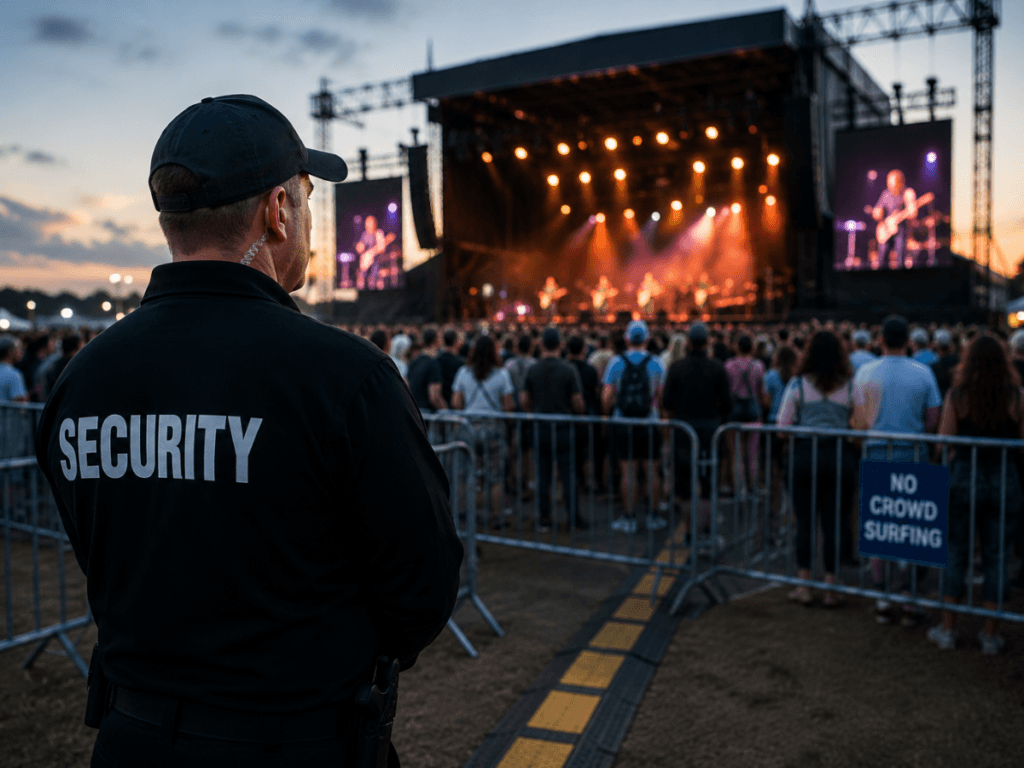
Large music events create constantly changing safety conditions. Attendees arrive in waves, gather near stages, move between attractions, and leave through a limited number of exits. Without a coordinated plan, ordinary movement can quickly create congestion, confusion, or dangerous crowd pressure.
Professional concert security addresses these risks through advance planning, trained personnel, clear communication, and continuous monitoring.
The goal is not simply to respond when someone becomes disruptive. It is to understand how people are likely to move through the venue, identify pressure points early, and keep the event operating safely from entry through final departure.
Crowd Management Begins Before the Gates Open
Effective crowd management starts with a detailed assessment of the venue and event schedule.
Security planners should understand expected attendance, entrance capacity, stage placement, emergency routes, concession areas, transportation access, and any locations where people are likely to gather.
The security plan should account for predictable surges, including:
- Gate openings and ticket-scanning periods
- The start and end of major performances
- Movement between stages at multi-artist festivals
- Weather interruptions or schedule changes
- Final exits, rideshare pickup, and parking-lot traffic
Staffing can then be matched to the venue rather than spread evenly without regard to risk. Entrances, front-of-stage barriers, narrow walkways, alcohol service areas, backstage access points, and emergency exits usually require different levels of attention.
This planning also helps organizers determine where barriers, directional signs, lighting, surveillance cameras, and medical resources should be positioned.
How Concert Security Manages Crowd Movement in Real Time
Once the event begins, security teams must continuously evaluate how conditions are changing. A route that was clear during the opening act may become congested when a headliner takes the stage. A sudden storm or technical interruption may redirect thousands of people within minutes.
Trained personnel look for signs that movement is becoming unsafe, such as:
- Crowds gathering faster than an area can accommodate
- Attendees moving against the main flow of foot traffic
- Blocked exits or restricted emergency access
- Pressure building near barricades or stage fronts
- Confusion caused by poor signage or conflicting instructions
- Aggressive behavior, medical distress, or visible panic
Visible security personnel also give attendees a clear place to ask for help. Their presence can discourage misconduct, but positioning matters more than simply having a large number of guards.
Staff must be placed where they can observe conditions, communicate with supervisors, and intervene without creating additional congestion.
Communication Connects Every Part of the Security Plan
Crowd control becomes less effective when security, event staff, medical teams, and venue management operate separately. Everyone responsible for safety should understand who makes decisions, how incidents are reported, and what actions different alert levels require.
Reliable communication may involve radios, assigned channels, command posts, camera monitoring, and clearly defined escalation procedures. Public-address announcements and digital signs can then be used to direct attendees without spreading conflicting information.
Instructions should be brief and specific. Telling people which gate to use, which route is closed, or where shelter is available is more useful than issuing vague warnings. Staff positioned throughout the venue should receive the same information so attendees hear consistent guidance.
Technology can improve awareness, but it does not replace trained judgment. Cameras may reveal crowd buildup, while access-control systems may show unusual entry activity.
Security personnel still need to interpret what is happening and determine whether the situation requires redirection, added staffing, medical support, or a broader emergency response.
Crowd Control Should Protect Safety Without Harming the Experience
Heavy-handed security can create tension, while an understaffed event can leave attendees feeling unprotected. Strong concert security finds the balance between maintaining control and allowing guests to enjoy the event.
That balance depends on professional conduct. Security staff should communicate calmly, treat attendees consistently, and understand when a situation can be resolved through guidance rather than confrontation.
They also need clear procedures for prohibited items, intoxicated guests, restricted areas, lost children, medical emergencies, and removals.
When planning, staffing, and communication work together, security becomes part of a well-run event rather than an obstacle within it. Attendees can move more confidently, staff can respond faster, and organizers are better prepared for both routine challenges and unexpected emergencies.
Research on mass-event safety emphasizes that crowd management must combine advance risk assessment with practical procedures that can adapt as conditions change.
The 2026 study Crowd Management Strategies in Mass Events: Theoretical and Practical Approaches examines how planning, observation, communication, and coordinated response contribute to safer high-attendance events.
This approach reflects an important principle for organizers: crowd safety cannot be reduced to barriers, cameras, or guard numbers alone. Effective crowd control requires those tools to operate within a unified plan built around the venue, the audience, and the event itself.
Managing Large Crowds Safely From Entry to Exit
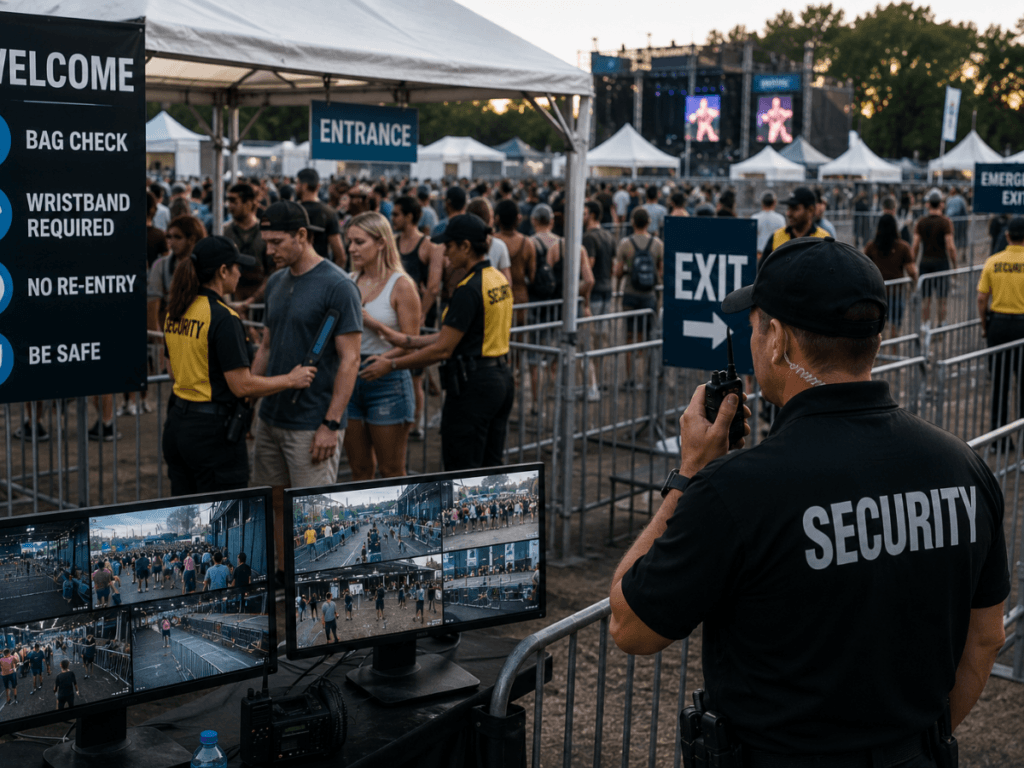
Crowd safety depends on more than maintaining a visible security presence. Concerts and festivals require a coordinated system for screening arrivals, managing access, monitoring audience behavior, and responding when conditions change.
A security plan should account for the full event cycle, including gate opening, peak attendance, movement between performance areas, and the final departure period.
Professional concert security teams use trained personnel, surveillance tools, access controls, and reliable communication to maintain awareness throughout the venue.
When these elements work together, organizers can identify developing problems earlier and respond without creating unnecessary disruption for attendees.
Control Entry Without Creating Dangerous Bottlenecks
The first major crowd-management challenge often occurs before guests enter the venue. Large numbers of people may arrive within a short period, particularly near opening time or before a headline performance.
Poorly organized screening and ticket checks can create long lines, crowd pressure, and frustration before the event has even begun.
Entry procedures should move people through security at a steady, manageable pace while preventing unauthorized access. Depending on the venue and event, this may involve:
- Separate lanes for general admission, VIP guests, staff, vendors, and performers
- Digital ticketing or electronic guest lists that speed up identity and admission checks
- Credential systems that clearly show which restricted areas a person may enter
- Bag inspections and prohibited-item screening at designated checkpoints
- Staff positioned before the gates to answer questions and direct attendees to the correct line
Security planners should also consider what happens when a ticket cannot be scanned, a guest arrives at the wrong entrance, or a prohibited item is found. Moving these situations to a separate resolution area prevents one problem from slowing the entire line.
Exits deserve the same level of planning. Emergency doors must remain clear, while routine departure routes should be easy to identify and capable of handling a sudden increase in foot traffic.
Match Access Credentials to Each Area of the Venue
Not everyone inside a concert or festival should have access to the same spaces. Backstage areas, production zones, performer entrances, equipment storage, control rooms, and VIP sections require additional protection.
A layered credential system allows security personnel to identify access permissions quickly. Wristbands, badges, lanyards, or digital credentials should be visually distinct and difficult to transfer between people.
Staff assigned to restricted areas must also understand which credentials are valid rather than relying only on whether someone appears to belong there.
Access control becomes especially important at multi-day festivals, where vendors and temporary workers may enter and leave repeatedly. Clear credential policies reduce confusion and make it easier to identify someone who is in the wrong location.
Cameras positioned near gates and restricted entrances can provide supporting evidence when an incident occurs, but surveillance should reinforce physical access control rather than replace it.
Monitor Crowd Density and Behavior Throughout the Event
Once attendees are inside, the security focus shifts from admission to movement and behavior. Conditions can change quickly when performances begin, alcohol consumption increases, weather shifts, or guests move between stages.
Security personnel should monitor more than individual misconduct. They also need to watch how the crowd is behaving as a whole. Warning signs may include:
- Increasing pressure near stage barricades
- Walkways becoming difficult to navigate
- Groups moving against the main direction of travel
- Attendees climbing structures or entering restricted spaces
- Growing agitation after delays or schedule changes
- Signs of medical distress, panic, or intoxication
- Emergency exits becoming blocked
These observations should be shared with a central supervisor or command team. A developing bottleneck may require additional personnel, temporary barriers, redirected foot traffic, or an announcement before it becomes a serious hazard.
Technology can strengthen this process. Cameras, occupancy data, and communication systems can provide a broader view of the venue, while officers on the ground contribute context that a video feed may not capture.
Coordinate Fast, Proportionate Responses
A strong concert security plan gives personnel clear instructions for common incidents, including fights, medical emergencies, missing children, severe weather, unauthorized access, and evacuation orders.
Responses should be proportionate to the situation. Not every concern requires removing an attendee or stopping a performance. Some issues can be resolved by opening another route, adding staff to a crowded area, giving clearer directions, or separating individuals before a conflict escalates.
Security, medical teams, event management, and production staff must also know who has authority to make larger operational decisions. Reliable radio procedures and defined escalation paths reduce delays when fast action is needed.
Managing large crowds safely is an ongoing process, not a task completed when the gates close. By controlling access, tracking movement, and responding early, concert security teams help protect attendees while allowing the event to continue with as little disruption as possible.
Emergency Planning for Live Events
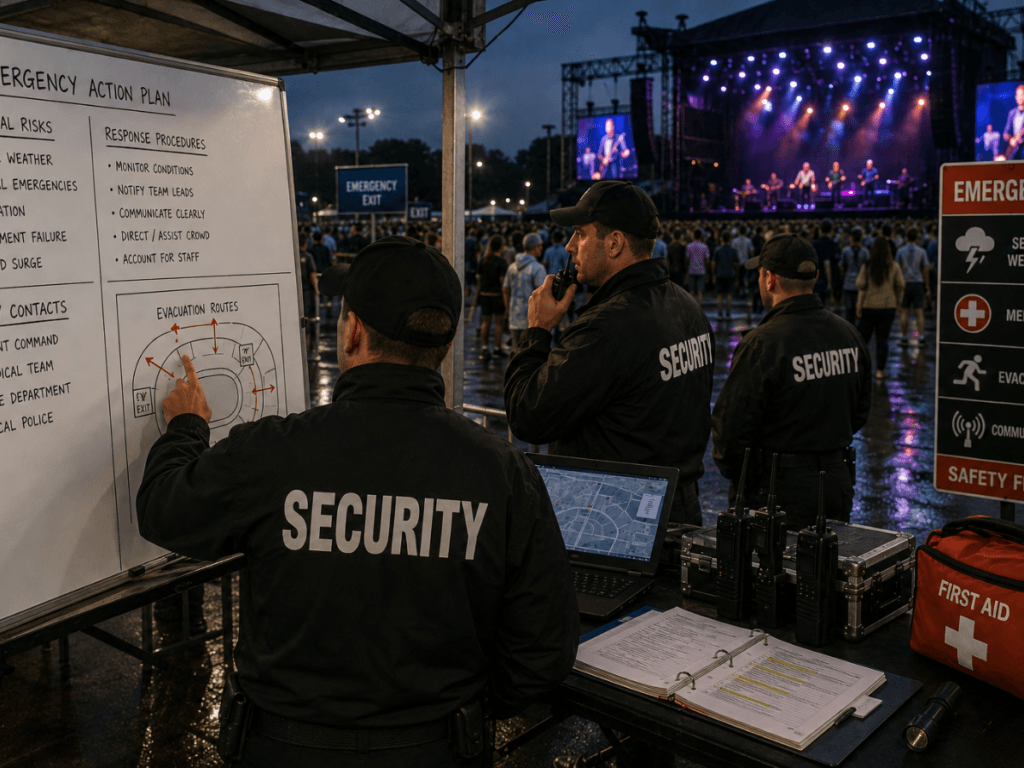
Even the best crowd management strategy cannot eliminate every risk. Severe weather, medical emergencies, equipment failures, or unexpected crowd behavior can develop with little warning, making emergency planning a critical part of any successful event.
Professional concert security focuses on preparing for these situations before gates open so teams can respond quickly, communicate clearly, and protect attendees with minimal disruption.
An effective emergency plan is built around the specific event rather than relying on a generic template. Venue layout, expected attendance, weather forecasts, artist requirements, and local emergency resources all influence how security teams prepare for potential incidents.
Conduct a Thorough Risk Assessment Before the Event
Every emergency response plan begins with understanding what could go wrong and how likely those scenarios are to occur. A comprehensive risk assessment allows organizers to identify vulnerabilities and implement preventative measures before attendees arrive.
Areas that should be evaluated include:
| Risk Assessment Area | Why It Matters |
|---|---|
| Venue layout | Identifies potential bottlenecks, restricted areas, emergency exits, and emergency vehicle access routes. |
| Crowd size and audience profile | Helps determine staffing levels, security deployment, and medical support requirements. |
| Weather conditions | Prepares organizers for extreme heat, lightning, heavy rain, or high winds that may require operational changes. |
| Performance schedule | Anticipates crowd surges during headline acts, stage changes, or event closing times. |
| Infrastructure and utilities | Reviews power systems, lighting, communication equipment, and other operational dependencies. |
The goal is not simply to identify hazards but to reduce the likelihood of those hazards affecting attendees through proactive planning.
Develop an Emergency Response Plan Everyone Understands
Once risks have been identified, organizers should create detailed response procedures for the incidents most likely to occur. A written emergency plan ensures every team understands how to respond under pressure instead of making decisions on the spot.
A comprehensive emergency response plan should address:
- Medical emergencies requiring first aid or ambulance response.
- Severe weather procedures, including sheltering or evacuation.
- Fire or hazardous material incidents.
- Crowd disturbances or disorderly behavior.
- Lost children or vulnerable attendees.
- Equipment failures, power outages, or stage-related emergencies.
- Full or partial venue evacuations.
Each procedure should identify who makes decisions, how information is communicated, and what actions different teams are expected to take. This level of preparation helps reduce confusion during rapidly changing situations.
Coordinate Security, Medical, and Emergency Services
Large events rely on more than security personnel alone. Effective emergency management depends on close coordination between multiple organizations before and during the event.
Planning should include collaboration with:
- Local law enforcement.
- Fire departments.
- Emergency medical services.
- Venue management.
- Event organizers and production teams.
- Traffic management and parking personnel.
Pre-event planning meetings help establish communication channels, clarify responsibilities, and ensure everyone understands how different agencies will work together if an incident occurs.
For larger festivals, many organizers also establish a central command post where representatives from each team can monitor conditions, share information, and coordinate decisions in real time.
Train Teams Before Emergencies Happen
Even the most detailed emergency plan has limited value if personnel have never practiced using it.
Regular training helps security staff become familiar with emergency procedures while improving communication and decision-making under pressure.
Depending on the event, preparation may include tabletop exercises, venue walkthroughs, evacuation drills, radio communication testing, and scenario-based training for incidents such as medical emergencies or severe weather.
Professional concert security teams also benefit from clearly defined leadership structures. Supervisors, security officers, medical personnel, and event staff should understand their responsibilities before an emergency occurs, allowing teams to respond confidently instead of waiting for direction.
Research Spotlight: Effective Emergency Planning Requires Coordination
Research continues to show that successful emergency management depends on both thorough planning and coordinated execution.
The 2023 study Hazard Identifications as a Risk Management Process in Music Festival emphasizes that identifying risks is only the first step. Organizers should also develop practical mitigation strategies that address those risks throughout every stage of the event.
Complementing this work, The Event Chain of Survival in the Context of Music Festivals (2017) highlights the importance of integrating security personnel, healthcare providers, emergency responders, and event organizers into a unified response framework.
When these groups share information, establish clear communication protocols, and train together before an event, they are better equipped to respond quickly and protect attendees when unexpected situations arise.
Ultimately, strong emergency planning supports every aspect of concert security. It enables faster decision-making, improves coordination between teams, and helps create a safer environment where organizers, performers, and attendees can focus on the event with greater confidence.
Training Security Teams for Large Events
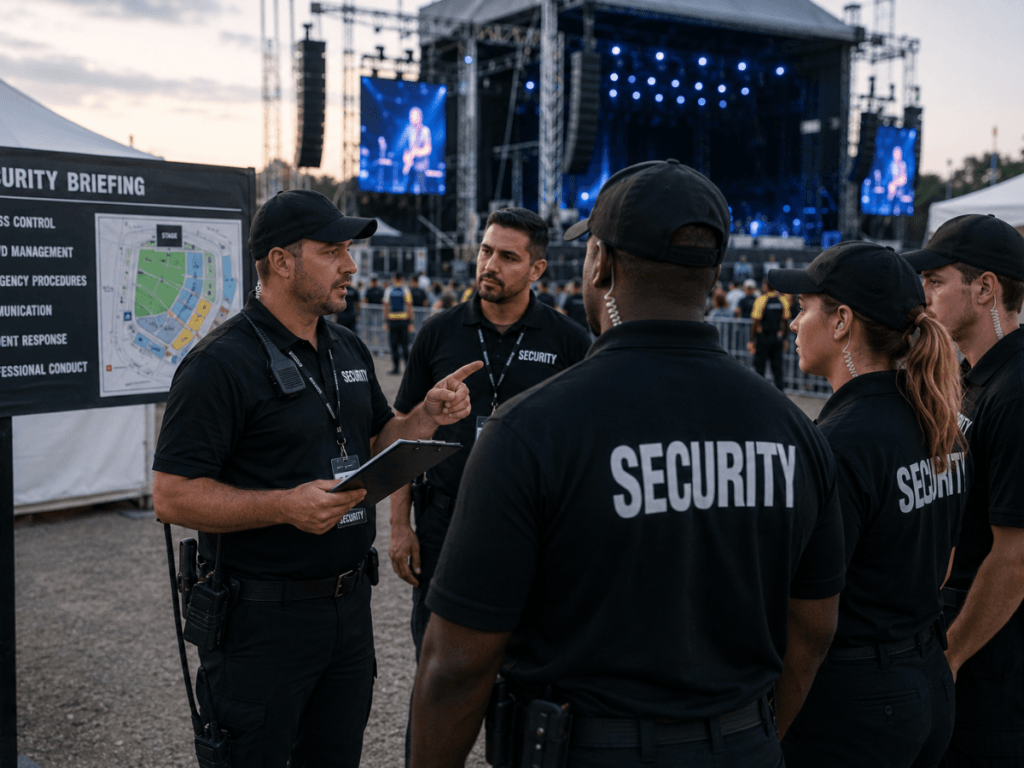
The success of a security plan ultimately depends on the people responsible for carrying it out. Even with detailed procedures and modern surveillance technology, untrained personnel can struggle to make sound decisions when conditions change.
Professional concert security requires individuals who can assess situations quickly, communicate effectively, and respond with confidence while maintaining a positive experience for attendees.
Because concerts and music festivals involve large crowds, changing environments, and multiple stakeholders, security personnel must be prepared for far more than access control.
They need the judgment to recognize developing risks, the communication skills to guide attendees calmly, and the professionalism to resolve incidents before they escalate.
Core Skills Every Event Security Professional Should Have
Effective event security relies on a combination of technical knowledge and interpersonal skills. Security personnel are often the first point of contact for attendees seeking assistance, reporting a concern, or responding to an emergency.
The most valuable skills include:
| Skill | Why It Matters |
|---|---|
| Situational awareness | Helps officers recognize developing risks before they become larger incidents. |
| Communication | Supports clear coordination with guests, supervisors, medical teams, and emergency responders. |
| Conflict de-escalation | Resolves disagreements professionally while reducing the likelihood of physical confrontations. |
| Decision-making under pressure | Enables personnel to respond quickly without creating unnecessary panic or confusion. |
| Customer service | Creates a welcoming environment while maintaining security standards. |
| Team coordination | Ensures security personnel can work effectively alongside venue staff and public safety agencies. |
While physical presence remains important, today’s security professionals are expected to combine observation, communication, and problem-solving to keep events operating safely.
Why Specialized Event Training Matters
Concerts and festivals present challenges that differ from those encountered in retail, office, or residential security. Large crowds, live performances, changing schedules, alcohol service, VIP areas, and unpredictable audience movement all require specialized preparation.
Training for event security commonly covers:
- Crowd dynamics and crowd behavior.
- Emergency evacuation procedures.
- Medical incident awareness and response protocols.
- Radio communication and incident reporting.
- Access control and credential verification.
- Customer interaction and conflict resolution.
- Venue-specific operating procedures.
Scenario-based exercises are particularly valuable because they allow personnel to practice responding to realistic situations before an event takes place. Walking through emergency procedures, testing communication systems, and conducting tabletop exercises help teams build confidence and improve coordination.
Professional Certifications Support Higher Standards
While certification requirements vary depending on location and employer, professional credentials demonstrate a commitment to ongoing education and recognized industry standards.
Examples of widely recognized certifications include:
- Certified Protection Professional (CPP): Focuses on security management, risk assessment, and organizational security practices.
- Physical Security Professional (PSP): Emphasizes physical security planning, facility protection, and vulnerability assessment.
Many organizations also provide specialized training in crowd management, emergency response, first aid, and event operations. These programs help security professionals stay current with evolving best practices and emerging risks associated with large public gatherings.
Continuous Training Improves Every Event
Training should not end after initial certification. Every concert provides opportunities to refine procedures, improve communication, and strengthen future planning.
Many experienced event security providers conduct pre-event briefings, post-event debriefings, and regular refresher training to identify what worked well and where improvements can be made.
Reviewing incidents, evaluating response times, and gathering feedback from supervisors helps teams prepare for increasingly complex events.
As venues adopt new technologies and audience expectations continue to evolve, ongoing education becomes an essential part of delivering reliable concert security.
Well-trained personnel are better equipped to protect attendees, support event organizers, and adapt confidently when unexpected situations arise, making continuous professional development one of the most valuable investments an event security organization can make.
How Technology Strengthens Modern Event Security
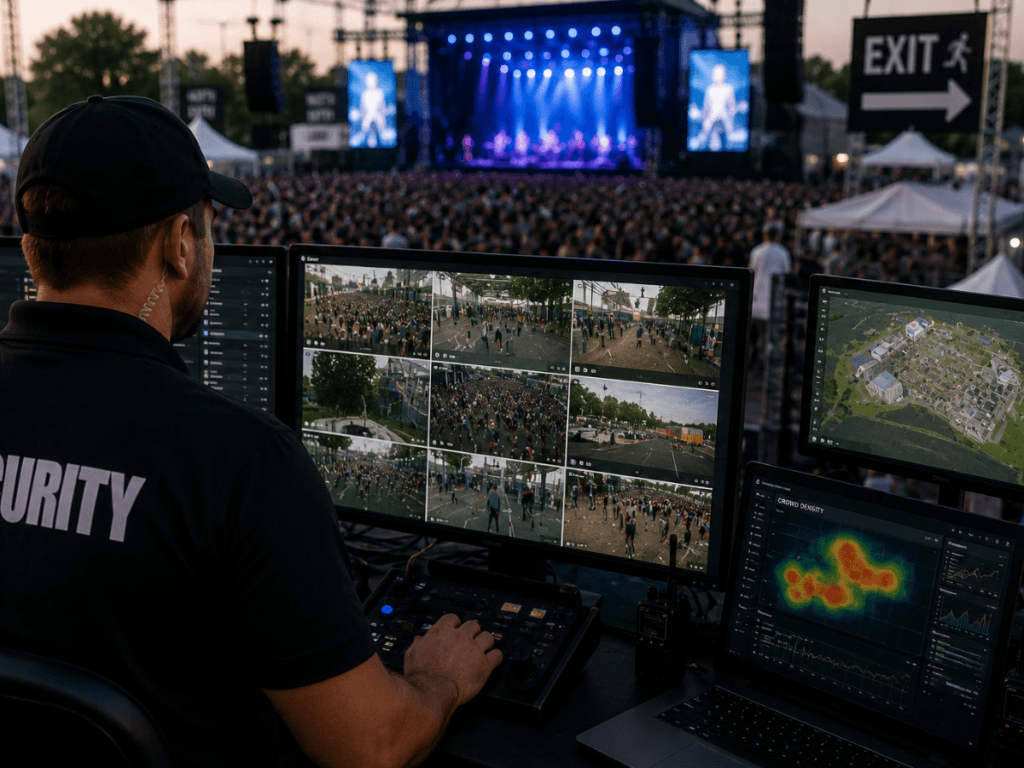
Technology has become an essential tool for managing large concerts and music festivals, but it is most effective when it supports trained personnel rather than replacing them.
Modern security systems give teams a clearer picture of what’s happening across the venue, helping them detect developing issues, coordinate responses, and make informed decisions in real time.
For professional concert security, technology improves both operational efficiency and situational awareness. When integrated into a broader security strategy, digital tools help reduce blind spots, streamline communication, and support safer experiences for attendees, performers, and staff.
Real-Time Monitoring Helps Teams Respond Faster
Large venues can be difficult to oversee from a single location. Security personnel stationed on the ground have an immediate view of their assigned area, while technology provides a broader perspective across the entire event.
Many venues use a combination of tools, including:
| Technology | How It Supports Security Operations |
|---|---|
| CCTV and security cameras | Monitor entrances, exits, stages, concourses, parking areas, and other high-traffic locations. |
| Live monitoring stations | Allow supervisors to track crowd movement and identify developing issues across multiple areas simultaneously. |
| Mobile communication systems | Enable security personnel to share updates and coordinate responses without delay. |
| Incident reporting software | Records security events in real time to improve coordination and post-event review. |
These systems help security teams identify congestion, suspicious activity, medical incidents, or unauthorized access before they escalate into larger problems.
Technology also creates a valuable record of event activity. Reviewing footage and incident reports after an event allows organizers to evaluate staffing levels, improve traffic flow, and refine future security plans.
Smarter Access Control Improves Safety and Efficiency
Entry management is one of the busiest phases of any concert or festival. Technology helps move attendees through screening more efficiently while maintaining control over who can enter the venue or access restricted areas.
Depending on the event, organizers may use:
- Digital ticket validation and electronic guest lists.
- RFID wristbands or credential systems for staff, vendors, performers, and VIP guests.
- Barcode or QR code scanning to speed admission.
- Camera systems positioned at entry points to support oversight and incident investigations.
These technologies reduce manual processing, shorten wait times, and make it easier to identify unauthorized access attempts.
Credential systems also simplify movement within the venue. Instead of relying on paper passes or visual recognition, security personnel can quickly verify whether someone is authorized to enter backstage areas, production zones, media spaces, or other restricted locations.
Technology Works Best Alongside Trained Security Personnel
While digital tools provide valuable information, they cannot replace professional judgment. Cameras may detect unusual activity, but trained officers determine whether that activity requires intervention.
Access control systems verify credentials, but security personnel still manage interactions with attendees and respond when problems arise.
Successful concert security combines technology with experienced professionals who understand crowd behavior, venue operations, and emergency procedures. This partnership allows teams to react quickly while maintaining a calm and organized environment.
As technology continues to evolve, many venues are adopting more integrated security platforms that connect surveillance, communication, access control, and incident reporting into a single operational system.
These tools improve coordination, but they remain most effective when supported by well-trained personnel, clear procedures, and comprehensive event planning.
Ultimately, technology should strengthen, not replace, the human element of event security. Used strategically, it gives organizers greater visibility, faster access to information, and better tools for protecting everyone at the event.
Frequently Asked Questions
What Does Concert Security Include?
Concert security covers much more than checking tickets or monitoring entrances.
A comprehensive security program typically includes crowd management, access control, emergency planning, surveillance, backstage and VIP protection, incident response, communication with emergency services, and ongoing monitoring throughout the event.
The goal is to protect attendees, performers, staff, and venue assets while maintaining a safe and enjoyable experience.
How Many Security Personnel Does a Concert Need?
There is no universal staffing ratio because every event has different security requirements.
The appropriate number of personnel depends on factors such as expected attendance, venue size, event layout, alcohol service, performer profile, local regulations, and the results of the event’s risk assessment.
Larger or higher-risk events generally require more security staff and additional coordination with law enforcement and emergency medical services.
What Is the Difference Between Crowd Management and Concert Security?
Crowd management is one component of concert security. It focuses on directing attendee movement, preventing congestion, and maintaining orderly pedestrian flow throughout the venue.
Concert security has a broader scope that includes access control, emergency response planning, surveillance, incident management, asset protection, and coordination with public safety agencies.
What Technology Is Commonly Used for Concert Security?
Modern concert security often combines CCTV surveillance, access control systems, digital ticket validation, RFID credentials, mobile communication devices, and incident reporting software.
These technologies improve situational awareness and help security teams respond more quickly while supporting better coordination across the venue.
How Can Event Organizers Prepare for Security Emergencies?
Preparation begins with a detailed risk assessment that evaluates the venue, expected attendance, potential hazards, weather conditions, and emergency access routes.
Organizers should also develop written response procedures, coordinate with local police, fire, and EMS agencies, train event staff, and conduct pre-event briefings or emergency drills before attendees arrive.
Why Is Professional Training Important for Concert Security Teams?
Live events present unique challenges that require specialized skills. Well-trained security personnel understand crowd behavior, conflict de-escalation, emergency procedures, communication protocols, and venue operations.
Ongoing training also helps teams adapt to new technologies, evolving security risks, and changing industry best practices, leading to safer and more effective event operations.
Professional Crowd Control for Concerts and Music Festivals
Successful music festivals and concerts rely on more than great performances. They also require experienced crowd control professionals who can help maintain a safe, organized environment for attendees, performers, and event staff.
From managing entry points and monitoring large crowds to responding quickly when situations arise, professional security services play a vital role in keeping events running smoothly. For dependable event security and crowd management solutions, choose Southeast Security Services.
If you’re planning a concert, festival, or large public event, call (404) 504-7023 to speak with the team at Southeast Security Services or fill out the website form to request your free estimate today.